
History and Building
In 1092 Hugolina, wife of the Norman Sheriff who built the first castle on Castle Hill, recovered from a serious illness. In thanksgiving, she founded or endowed St Giles’ Church. The church may, however, be older than this. One of the oldest surviving features is the chancel arch, which appears more Saxon than Norman in style. This suggests that Hugolina may have supported an existing church rather than establishing a new one.
The medieval church was altered many times. A large extension was added in the 1800s, but this gave the building an awkward floorplan. In 1875 a new church was built on the north side of the old one, designed by Healey of Bradford in the Early English style. Remarkably, the old church remained in use until the new building was consecrated on 5 June 1875. The cost was £10,000. Some parts of the earlier churches were incorporated into the present one. These include the 11th-century chancel arch, the 16th-century entrance arch, foundations, monuments, and other furnishings. The first vicar, Rev. Francis Slater, played a key role in turning what began as a bare new interior into the richly decorated building we see today. If you stand in the porch, you will look out onto where the first church used to stand.
.png)
The old church, with the new church being built in the background
Entrance
Just inside the main doors, above the entrance, there is a plaster copy of Michelangelo’s Taddei Tondo of 1505. The sculpture, which shows the Virgin and Child with the infant St John, was originally commissioned by the Taddei family. In this copy, St John is on the left holding a baptismal bowl, while Jesus holds a small bird, possibly a goldfinch. The donor of the plaster copy is unknown, but such reproductions were widely available in the early 19th century.
The font comes from the original Norman church and is thought to be earlier than the 15th century. It is very simple, octagonal in shape, and lacks the carved decoration usually found on fonts of the period. It may once have been painted.
Two restored candle chests from the 17th century stand nearby. One has marquetry flowers on the front, although they are faint and may be easier to see with the aid of torchlight. The chancel arch, decorated with chevron patterns, also survives from the original church and may be Saxon in origin.
_edited.jpg)
Plaster copy of Michelangelo’s Taddei Tondo of 1505

Detail of one of the 17th Century candle chests
Lady Chapel
Through the arch and up the steps, past a wrought-iron gate made by parishioner Mr Fry, lies the Lady Chapel. At the small altar there is a painted scene of the Annunciation behind the frontal. This is an 18th-century copy of Veronese’s Adoration of the Kings, given to the old St Giles’ in 1803 to serve as a reredos. The original is at Chatsworth, and another version is in Dresden Museum.
If the altar frontal is not in place, you can also see a painting of Mary and Elizabeth, showing the moment when Mary visits her cousin to share the news of the Holy Spirit. This is a copy of Mariotto Albertinelli’s Visitation (1474–1515), though with some small differences in background and colour.
.png)
Altar in Lady Chapel
.png)
Detail of painting of Mary meeting Elizabeth
_edited.jpg)
Albertinelli's painting
Work by Ninian Comper
The early 20th-century designer Ninian Comper, who had trained under Bodley and Kempe, designed several features for the church, including the dark oak panelling on the west wall (shown below, together with his original plan), altar screen, a credence table, and a prayer desk for the Lady Chapel. His trademark strawberry (chosen in memory of his father, who died after giving strawberries to poor children) can be seen in one of the west windows. Comper also advised that the Lady Chapel be improved with a blue carpet, a credence table, and a prayer desk, all of which were provided in memory of parishioners. The blue carpet is new, but the other pieces, which he designed, remain.
_edited.jpg)
Prayer desk

Credence table

Altar screen (no longer in original position around altar)
.png)
Oak panelling on the west wall

Detail from Comper's original design
_edited_edited.jpg)
Comper's "signature" strawberry
Stained Glass and Monuments
Windows on the south wall of the Lady Chapel, made in 1907 by Charles Kempe’s company, show Mary visiting Elizabeth and the Nativity. Above the Lady Chapel altar is Kempe’s Annunciation window. Kempe (1837–1907) was a pupil of William Morris and assistant to architect G.F. Bodley. He had wished to become a clergyman, but had a speech impediment which, he realised, would stop him from preaching well. So he decided that “if he was not permitted to minister in the Sanctuary he would use his talents to adorn it”. Kempe often marked his designs with a sheaf of corn, from his family crest, or with the crest itself. After his death, his stained-glass workshop was taken over by his cousin, Walter Towers, who added a tower to the sheaf of corn symbol. Kempe’s workshop also produced the windows in the east wall of the chancel, which commemorate Rev. Francis Slater. These windows show Christ in Glory with the dove of the Holy Spirit above the apostles, St Peter at Emmaus, and St Giles with his hart alongside the risen Christ’s words to Mary Magdalene: “Do not touch me.” Above them, the rose window shows angels in roundels.
The monuments in the church are mostly plaques from the early 19th century, but there are older ones. The most notable is that of Nicholas Carre, Regius Professor of Greek, dating from 1558. Although much restored, it was moved from the Norman church. The former churchyard, now called the Cemetery of the Ascension and located off Huntingdon Road, contains the graves of many academics.
In 1888 Rev. Slater also commissioned a series of eighteen stained-glass windows from Heaton, Butler and Bayne of London. These were sponsored by individuals in memory of loved ones.

Kempe's crest
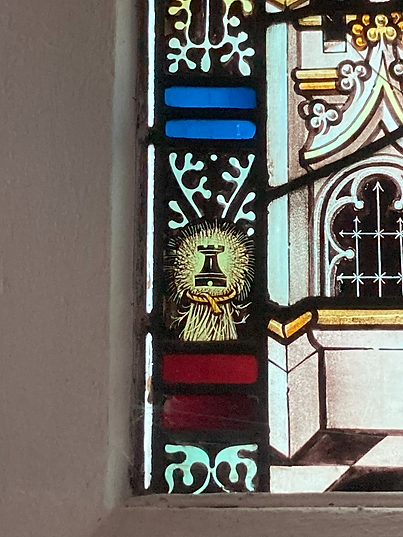.png)
The tower added to the cornsheaf
Chancel & Sanctuary
Moving through the chancel, we come to the sanctuary, which is quite theatrical in design. The altar is raised, and was done so several times over the years. The east wall is dominated by the triptych. (During Lent it is kept closed.) Its central mosaic, installed by 1888, shows the risen Christ making breakfast for his disciples after fishing, and, symbolically, giving keys to St Peter. Around 1913–14 Rattee and Kett of Cambridge, known for their woodcarving at the Palace of Westminster, added the surrounding structure with painted saints and angels. Male saints George, Giles, John, and Joseph appear on one side, while female saints Mary, Anne, Etheldreda, and Katherine of Alexandria appear on the other. Above them are beautifully painted angels.
The fixed altar rails are said to be by Christopher Wren and acquired by Dr Benson (Magdalene College) from a redundant Anglican church in Rotterdam in 1913. The walls retain traces of earlier decoration in red and gold, including the monogram IHS. Like many Cambridge churches, St Giles was whitewashed in the early 20th century, which covered much of the original painted decoration.
_edited.jpg)
Remains of wall painting
.png)
Organ
Organ
The organ was built by Miller of Cambridge using pipework from earlier sources. It was rebuilt some fifty years ago by E.J. Johnson and Sons, who continue to maintain it. The instrument has three manuals and is admired by organists for its sound quality.
Choir & Ceiling
The choir is now little used in services, as worship centres on the altar with the priest facing the people, but it is sometimes used by visiting college choirs. The choir stalls, given in 1901, are finely carved with images including grapes, corn, the hart of St Giles, the keys of St Peter, and a pelican. Four stalls contain misericords, which can be examined by lifting the seats.
The ceiling, blackened by years of smoke from candles, incense, and gas lighting, still shows its painted decoration when the light is right. The work was first undertaken by Frederick Leach, a master craftsman who worked on many Cambridge churches. Rev. Francis Slater organised the decoration in 1875–6, and a letter from him to Leach survives. A church magazine of April 1876 described the symbolism of the new ceiling paintings. Unfortunately, it is thought that it was repainted some years later, with a different design.
_edited_edited.jpg)
Painted ceiling
.png)
Rood Screen
Rood Screen
Going down the steps into the nave, we pass through the rood screen. “Rood” is old English for “cross” and at the top we see Christ on the cross, with Mary and John beside him. Such screens were common in the late Middle Ages, separating the priest’s rituals in the chancel from the congregation in the nave. This screen was made by Kett in 1887 in the Gothic Revival style. It is built of deal, a type of pine, and was later painted in rich reds, greens, and golds. This photograph was taken before the painted copper panels were added in 1902 by Barnett McLean Leach, son of Frederick Leach, showing figures such as Monica, David, Anne, Joseph, Mary, Isaiah, Magdalene, and Anselm, and although the mosaic is in place, the rest of the current reredos triptych will not appear for another decade or so.
Nave, Aisles, and Vestry
The nave and aisles are simple in form, built of brick with plaster covering. They are open and full of light from the clerestory and the lower stained-glass windows - a series of windows showing a representative saint or worthy Christian from each century - add glowing colour to the church. This wide, unpewed space has often been used for dancing, fairs, and festivals, such as the annual St Giles’ Fair in September.
The vestry in the north corner is entered through a 12th-century arch from the Norman church. The heavy wooden door was fitted in 1914, and, according to the church newletters, was “the gift of Mrs Dalton, was carved by her, and is not only a useful and necessary thing, but is a very fine piece of work, the design of it corresponding in date and style to the arch”

Carving above vestry door
.png)
Aisle of the church looking to west wall
Finishing touches
St Giles was never finished. The original plans show a wonderful belltower, that was never built. Inside, there are a few carved bosses, and more than a few which remain uncarved, there simply wasn’t the money. The first church newsletters of 1875 continually remind the congregation of the money owed to the kind guarantors who made the building possible. But the same newsletters also appeal for donations to the boys and girls schools, for help for the poor in the parish during winter, for the soup kitchen, and so on, so perhaps it is understandable that the much of it was left unfinished.
With thanks
Much of the work on the restoration of St Giles has been made possible through funding by the National Lottery Heritage Fund